
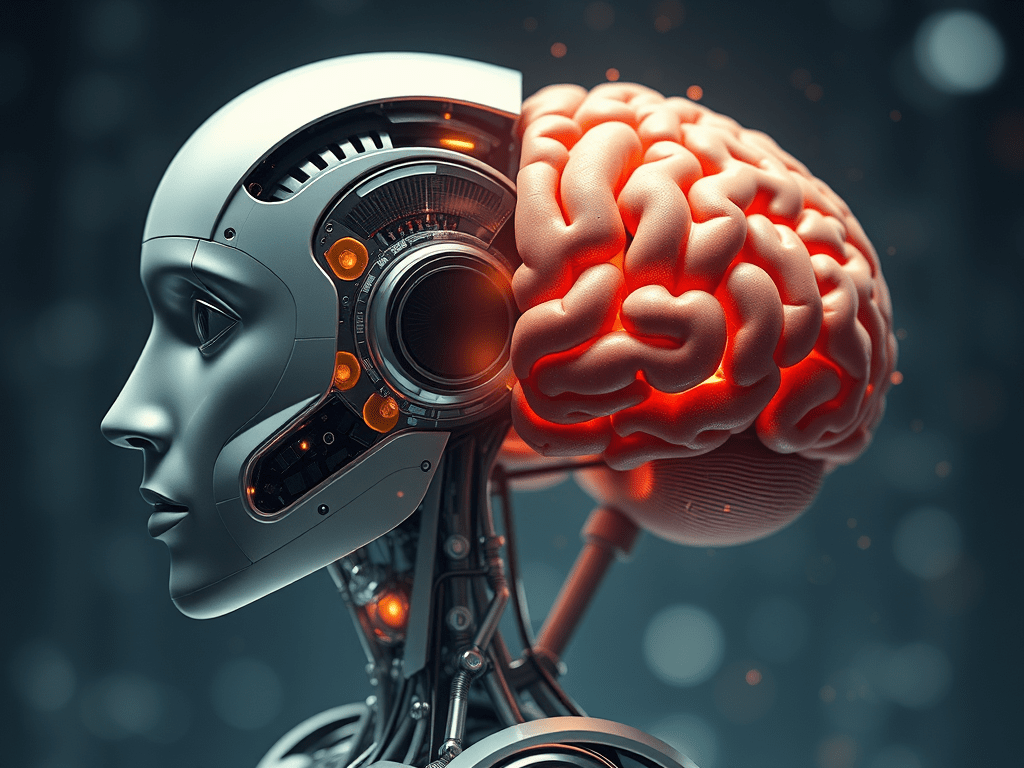
The Thinking Tool Artificial Intelligence has been christened with many words — a revolution, arousing, the future or an apocalypse.
Deciding what AI should be, but first understanding what it should not. AI is not alive. It does not behave and feel like a human. It has no wishes, wants nor feels anyway inside not even its voice. In its essence, AI is a combination of algorithms and data that allows the processing & response time much faster than any human could even think about.
It is “intelligence” but without consciousness… like a calculator … that can write poetry, drive a car or diagnose diseases. It is this duality that makes AI — and how it learns — so intriguing yet frightening. Yet, as with all tools in history, the ultimate effect of AI is defined by one thing: its wielders.
Chapter 2 — The Making of Artificial Intelligence
The idea of creating a thinking machine is as old as human imagination, from old myths of mechanical beings to the automata in the 18th century. It was only in the middle of the 20th century that modern AI was born.
A group of scientists coined the term “Artificial Intelligence” in 1956 at Dartmouth Conference. They wanted machines that could even think the way we solve problems. Fast forward to when computers were at their infant stage and took up entire rooms had little power compared to a smartphone today.
Those first AI programs could play simple games, solve math puzzles, but they were brittle and limited. The history of AI was all about booms — waves of enthusiasm followed by “AI winters” in which funding and interest dried up. Only in the last few decades, with the BIG DATA era and new computation power, AI really started to change things around us.
AI Works At The Core – A Story from Chapter 3
Even the name AI suggests that it has some kind of thinking process going on, but alas for better or worse at this point in history humans and animals do not have a digital means but rather an analog way of arriving at their conclusions so rest easy robots are nothing to worry about….Yet….. It takes in data and learns patterns from it, which it then uses to train the model to infer or produce something. One of the most familiar is probably machine learning, where an algorithm gets better at a task as it sees more examples.
If you feed an AI millions of cat pictures, it can learn the patterns — whiskers, tails, certain shapes of ears — and then start to pick out cats in new pictures it has never seen before.
AI models such as ChatGPT, are trained on large volumes of text which help in interpreting input questions and producing concise answers. Some are specifically designed for identifying objects, faces, or medical conditions such as image recognition systems.
Downside is that AI does not get semantics in the same way humans did. This makes you great at pattern recognition but without a clue of why those patterns matter.
Chapter 4: AI, Like Beauty, Is In the Eye of the Beholder
AI comes in many forms:
Narrow AI: Which is designed to perform just one task, like recommending a movie or translating languages.
– AGI — General Artificial Intelligence: the not-likely-to-exist AI created in our own image, with human-grade intelligence in all areas.
Machine Vision – AI that can see and interpret images.
- Natural Language Processing — AI that understands and creates human language.
Robotics: These are AI enabled physical machines working for us.
We use AI much more than you think — from Face ID on our phones everyday, to what shows up in our feeds on social media daily or how we route around traffic using a map app regularly.
Chapter 5 – Life and AI
Everywhere you will find AI in some form or the other:
Healthcare -Disease diagnosis and patient risk prediction.
Entertainment — Songwriters, Video Editors, Screenwriters.
Transportation (self-driving cars, logistics optimization)
– Customer Services — Chatbot can answers thousands of questions in a moment
When AI is invisible to us, it fits nearly seamlessly into our every day lives (and we may not even recognize).
Chapter 6 -The Lies, The Myths, and The Fears
Hollywood has conferred upon us the vision of killer robots and rogue supercomputers. Though these are good as stories, the real dangers today are more insidious: algorithmic bias, Orwellian surveillance, propaganda on an industrial scale.
Too creative, empathetic or moral, for instance — aspects instilled by humans and which AI lacks. It can help, but it will never be able to totally replace the incredibly broad range of human talent.
Chapter 7 — The power and the risks
The Strength of AI can also be the Greatest Risk — Speed and Scale Apparently, it is far faster than fact checker in its full spread of false information, well may be a cancer tumor is detected earlier to that of human doctor?
It creates art, music, literature (but also deep fakes and scams). The actual challenge is not in establishing more powerful AI but ensuring this power is induced ethically.
The ethics, bias and responsibility Assistant Chapter 9
AI is trained on data, and data is created by humans, so AI can learn human biases. Historically, this might not have necessarily been the case Thanks to casting our back at historical hiring data that most likely depicts fewer women in tech, an AI trained on this probably would also tend to hire more male applicants.
Responsible AI development involves testing for bias 9, providing transparency, and putting limits on how these models can be used ([ 20 ] (pp. There’s regulation and ethics in healthcare (ie. the Hippocratic Oath), financial regulations, as well as technical regulatory bodies — even AI use-cases need to have a framework that protects people but set a tone for innovation at the same time.
THE FUTURE WE ARE MAKING
The future of AI itself may be quite awesome: individualized medication, environment-friendly horticulture, climate modeling, scientific growths on ranges we can not even fathom … But that also raised possible pitfalls, including loss of jobs, ubiquitous corporate surveillance and a handful of companies wielding unprecedented control.
As AI evolves, it will go one way or the other, depending on how governments and companies choose to accelerate its growth as a general-purpose technology.
Conclusion: AI Back Where It Belongs — Chapter 10
But in the end AI is a mirror we hold up to ourselves. Humanity is a mirror on the universe, good or bad. It will never be good or bad by itself — it is as ethical or treacherous as the intent behind its use.
AI is not here to replace humanity. It is here to extend our reach, amplify our abilities, and challenge us to be better stewards of the tools we create. The question is not whether AI will change the world. It already has. The real question is: what kind of world do we want it to help build?
 Joshua T Craig
Leave a comment